| Date |
September 12, 2012 |
| Time |
8:30-10.30 hours |
| Marks |
50 |
Attempt all questions.
Answers should be brief and to the point.
Draw neat sketches.
Make suitable assumptions, if required, and all the assumptions should be stated clearly.
Intermediate steps should be show along with appropriate tabular forms to get full marks.
Write page numbers against the questions attempted
- [1609]
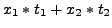
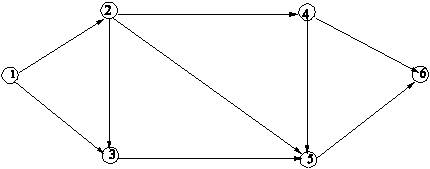
The free flow travel time on each link of the following network is given below. The demand from 1 to 5, 1 to 6, and 2 to 6 is 100 trips each,
and the BPR's travel time parameters,
 ,
,  , and k are 0.1, 2, and 120 respectively.
If the capacity of the link having highest flow is doubled, what will be the change in Total System Travel Time?
(10)
, and k are 0.1, 2, and 120 respectively.
If the capacity of the link having highest flow is doubled, what will be the change in Total System Travel Time?
(10)
| From |
To |
Free flow travel time |
| 1 |
2 |
10 |
| 1 |
3 |
12 |
| 2 |
4 |
20 |
| 2 |
3 |
8 |
| 2 |
5 |
30 |
| 3 |
5 |
25 |
| 4 |
5 |
10 |
| 4 |
6 |
8 |
| 5 |
6 |
9 |
| OD Pair |
Paths |
Free flow tt |
| |
1-2-4-6 |
38 |
| |
1-2-5-6 |
| |
1-3-5-6 |
| |
1-2-3-5-6 |
| |
1-2-4-5-6 |
| |
Min |
| |
2-3-5-6 |
42 |
| |
2-5-6- |
| |
2-4-6- |
| |
2-4-5-6 |
| |
Min |
| |
1-2-5- |
40 |
| |
1-3-5- |
| |
1-2-3-5 |
| |
1-2-4-5 |
| |
Min |
| From |
To |
t0 |
alpha |
beta |
K |
x1-6 |
x2-6 |
x3-6 |
x |
t |
x*t |
| 1 |
2 |
10 |
0.1 |
2 |
120 |
100 |
|
|
100 |
10.69 |
1,069.44 |
| 1 |
3 |
12 |
0.1 |
2 |
120 |
|
|
100 |
100 |
12.83 |
1,283.33 |
| 2 |
3 |
8 |
0.1 |
2 |
120 |
|
|
|
0 |
8.00 |
0.00 |
| 2 |
4 |
20 |
0.1 |
2 |
120 |
100 |
100 |
|
200 |
25.56 |
5,111.11 |
| 2 |
5 |
30 |
0.1 |
2 |
120 |
|
|
|
0 |
30.00 |
0.00 |
| 3 |
5 |
25 |
0.1 |
2 |
120 |
|
|
100 |
100 |
26.74 |
2,673.61 |
| 4 |
5 |
10 |
0.1 |
2 |
120 |
|
|
|
0 |
10.00 |
0.00 |
| 4 |
6 |
8 |
0.1 |
2 |
120 |
100 |
100 |
|
200 |
10.22 |
2,044.44 |
| 5 |
6 |
9 |
0.1 |
2 |
120 |
|
|
|
0 |
9.00 |
0.00 |
| |
TSTT |
12181.9 |
If the capacity of the link 2-4 is doubled, change in TSTT=12181.94-11348.61=833.33veh-min=13.89veh-hrs.
If the capacity of the link 4-6 is doubled, change in TSTT=12181.94-11848.61=333.33veh-min=5.5veh-hrs.
If the capacities of both 2-4 and 4-6 are doubled, change in TSTT=12181.94-11015.28=1166.66veh-min=19.44veh-hrs
[2019]
(i)
Suppose you were asked to do travel demand modelling for Greater Mumbai, illustrate the
study area,
internal zones,
external zones,
cordon line, and the
screen lines
(ii)Define the goal of transportation system analysis and state the assumptions.
(iii)State the trip distribution equation of the gravity model and derive the expression for production constant.
(iv) State Wardrop's first principles and show its mathematical representation. (12)
[1008]
The trip productions from zones 1, 2 and 3 are 110, 122 and 140 respectively and the trip attractions to these zones are 120,134 and 118 respectively.
Assume the peoples choice to destination is influenced inversely by the square of the distance.The distance matrix is given below.
Compute the trip matrix using doubly constrained gravity model. Provide one complete iteration.
(7)
Solution
 |
 |
 |
 |
 |
 |
 |
 |
| |
1 |
1.0 |
120 |
1.0 |
120.00 |
|
|
| 1 |
2 |
1.0 |
134 |
0.694 |
93.056 |
249.475 |
0.004 |
| |
3 |
1.0 |
118 |
0.309 |
36.420 |
|
|
| |
1 |
1.0 |
120 |
0.694 |
83.333 |
|
|
| 2 |
2 |
1.0 |
134 |
1.0 |
134 |
269.778 |
0.004 |
| |
3 |
1.0 |
118 |
0.444 |
52.444 |
|
|
| |
1 |
1.0 |
120 |
0.309 |
37.037 |
|
|
| 3 |
2 |
1.0 |
134 |
1.000 |
59.556 |
214.593 |
0.005 |
| |
3 |
1.0 |
118 |
1.00 |
118 |
|
|
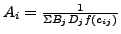
The second step is to find .
This can be found out as
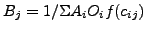 , where
  is obtained from the previous step.
|
|
|
 |
|
 |
 |
|
| |
1 |
0.004 |
110 |
1.000 |
0.441 |
|
|
| 1 |
2 |
0.004 |
122 |
0.694 |
0.314 |
0.956 |
1.046 |
| |
3 |
0.005 |
140 |
0.309 |
0.201 |
|
|
| |
1 |
0.004 |
110 |
0.694 |
0.306 |
|
|
| 2 |
2 |
0.004 |
122 |
1.000 |
0.452 |
1.048 |
0.954 |
| |
3 |
0.005 |
140 |
0.444 |
0.290 |
|
|
| |
1 |
0.004 |
110 |
0.309 |
0.136 |
|
|
| 3 |
2 |
0.004 |
122 |
0.444 |
0.201 |
0.989 |
1.011 |
| |
3 |
0.005 |
140 |
1.000 |
0.652 |
|
|
The function can be written in the matrix form as:
![$\displaystyle \left[
\begin{array}{ccc}
1.0&0.69&0.31 \\
0.69&1.0&0.44 \\
0.31&0.44&1.0 \\
\end{array}
\right]$](img17.png) |
(1) |
Then  can be computed using the formula
 |
(2) |
is the actual productions from the zone and  is the computed ones.
Similar is the case with attractions also.
is the computed ones.
Similar is the case with attractions also.
| |
1 |
2 |
3 |
|
|
|
| 1 |
55.327 |
39.137 |
16.229 |
0.004 |
110 |
110.694 |
| 2 |
39.406 |
57.802 |
23.969 |
0.004 |
122 |
121.177 |
| 3 |
25.266 |
37.061 |
77.802 |
0.005 |
140 |
140.129 |
|
1.046 |
0.954 |
1.011 |
|
|
|
 |
120 |
134 |
118 |
|
|
|
 |
120 |
134 |
118 |
|
|
|
is the actual productions from the zone and is the computed ones.
Similar is the case with attractions also.
Therefore error can be computed as ;

 [2101]
Build the minimum path tree from origin node 1 to all the other nodes for the following case:
(10)
[2101]
Build the minimum path tree from origin node 1 to all the other nodes for the following case:
(10)
| Link |
Travel time |
| 1-2 |
2 |
| 1-3 |
2 |
| 2-4 |
3 |
| 2-5 |
2 |
| 3-5 |
4 |
| 3-6 |
3 |
| 4-8 |
4 |
| 4-9 |
2 |
| 5-7 |
2 |
| 5-8 |
3 |
| 6-7 |
4 |
| 7-10 |
5 |
| 8-10 |
4 |
| 8-11 |
3 |
| 9-11 |
2 |
| 10-12 |
3 |
| 11-12 |
3 |
| O-D |
Shortest Path |
| 1-2 |
1-2 |
| 1-3 |
1-3 |
| 1-4 |
1-2-4 |
| 1-5 |
1-2-5 |
| 1-6 |
1-3-6 |
| 1-7 |
1-2-5-7 |
| 1-8 |
1-2-5-8 |
| 1-9 |
1-2-4-9 |
| 1-10 |
1-2-5-7-10 (or) 1-2-5-8-10 |
| 1-11 |
1-2-4-9-11 |
| 1-12 |
1-2-4-9-11-12 |
[1713]
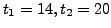
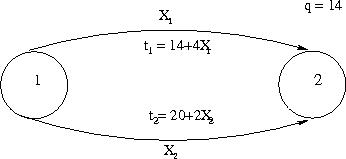
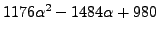
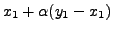
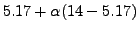
Calculate the system travel time and link flows by system optimum assignment using Frank Wolfe algorithm for a network with two nodes having two paths as links.
The travel time functions are  and
and  .
The total flow on the two links is limited to 14.
Assume a precison of 0.01 for convergence.
(7)
.
The total flow on the two links is limited to 14.
Assume a precison of 0.01 for convergence.
(7)
Given

Free flow time

By AON,
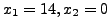
First iteration
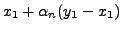
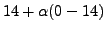
Step 1:


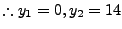
Step 2:
Step 3:

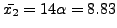
Second Iteration
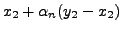
Step 1:


Step 2:
E O F
This document was generated using the
LaTeX2HTML translator Version 2002-2 (1.70)
Copyright © 1993, 1994, 1995, 1996,
Nikos Drakos,
Computer Based Learning Unit, University of Leeds.
Copyright © 1997, 1998, 1999,
Ross Moore,
Mathematics Department, Macquarie University, Sydney.
The command line arguments were:
latex2html -split 0 2012_midsem_sol.tex
The translation was initiated by Prof. Tom V. Mathew on 2012-09-24
Prof. Tom V. Mathew
2012-09-24
![\begin{displaymath}\left[
\begin{array}{ccc}
1.0&1.2&1.8 \\
1.2&1.0&1.5 \\
1.8&1.5&1.0 \\
\end{array}\right]\end{displaymath}](img3.png)















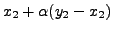
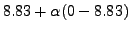










 Link flows:

 System travel time =