!h
Indian roads congress has specified the design procedures for flexible pavements based on CBR values. The Pavement designs given in the previous edition IRC:37-1984 were applicable to design traffic upto only 30 million standard axles (msa). The earlier code is empirical in nature which has limitations regarding applicability and extrapolation. This guidelines follows analytical designs and developed new set of designs up to 150 msa in IRC:37-2001.
These guidelines will apply to design of flexible pavements for Expressway, National Highways, State Highways, Major District Roads, and other categories of roads. Flexible pavements are considered to include the pavements which have bituminous surfacing and granular base and sub-base courses conforming to IRC/ MOST standards. These guidelines apply to new pavements.
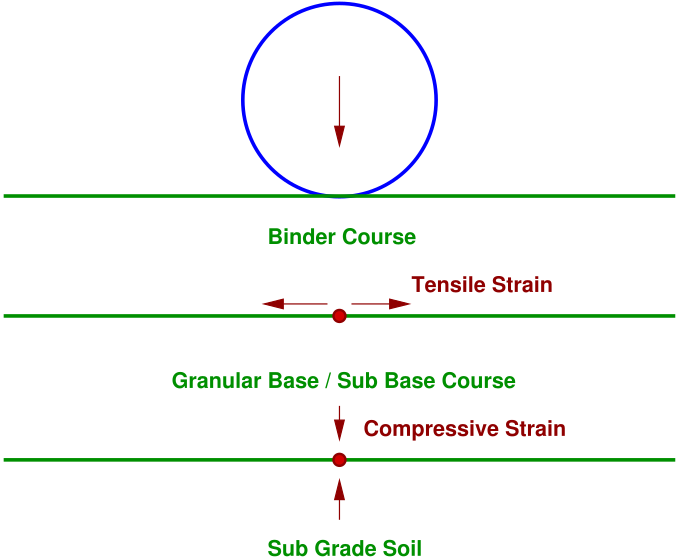
The flexible pavements has been modeled as a three layer structure and stresses and strains at critical locations have been computed using the linear elastic model. To give proper consideration to the aspects of performance, the following three types of pavement distress resulting from repeated (cyclic) application of traffic loads are considered:
While the permanent deformation within the bituminous layer can be controlled by meeting the mix design requirements, thickness of granular and bituminous layers are selected using the analytical design approach so that strains at the critical points are within the allowable limits. For calculating tensile strains at the bottom of the bituminous layer, the stiffness of dense bituminous macadam (DBM) layer with 60/70 bitumen has been used in the analysis.
!h
A and B are the critical locations for tensile strains \((\epsilon _t)\). Maximum value of the strain is adopted for
design. C is the critical location for the vertical subgrade strain \((\epsilon _z)\) since the maximum value of the \((\epsilon _z)\) occurs
mostly at C.
Fatigue Criteria:
Bituminous surfacings of pavements display flexural fatigue cracking if the tensile strain at the bottom of
the bituminous layer is beyond certain limit. The relation between the fatigue life of the pavement and
the tensile strain in the bottom of the bituminous layer was obtained as \begin {equation} N_f = 2.21\times 10^{-4}\times \left (\frac {1}{\epsilon _t}\right )^{3.89}\times \left (\frac {1}{E}\right )^{0.854} \label {fc11} \end {equation} in which, \(N_f\) is the
allowable number of load repetitions to control fatigue cracking and \(E\) is the Elastic modulus of
bituminous layer. The use of equation 1 would result in fatigue cracking of 20% of the total area.
Rutting Criteria
The allowable number of load repetitions to control permanent deformation can be expressed as \begin {equation} N_r = 4.1656\times 10^{-8}\times \left (\frac {1}{\epsilon _z}\right )^{4.5337} \label {pd1} \end {equation} \(N_r\) is the
number of cumulative standard axles to produce rutting of 20 mm.
Based on the performance of existing designs and using analytical approach, simple design charts and a catalogue of pavement designs are added in the code. The pavement designs are given for subgrade CBR values ranging from 2% to 10% and design traffic ranging from 1 msa to 150 msa for an average annual pavement temperature of 35 C. The later thicknesses obtained from the analysis have been slightly modified to adapt the designs to stage construction. Using the following simple input parameters, appropriate designs could be chosen for the given traffic and soil strength:
The method considers traffic in terms of the cumulative number of standard axles (8160 kg) to be carried by the pavement during the design life. This requires the following information:
Initial traffic
Initial traffic is determined in terms of commercial vehicles per day (CVPD). For the structural design of
the pavement only commercial vehicles are considered assuming laden weight of three tonnes or more and
their axle loading will be considered. Estimate of the initial daily average traffic flow for any road should
normally be based on 7-day 24-hour classified traffic counts (ADT). In case of new roads, traffic
estimates can be made on the basis of potential land use and traffic on existing routes in the area.
Traffic growth rate
Traffic growth rates can be estimated (i) by studying the past trends of traffic growth, and (ii) by
establishing econometric models. If adequate data is not available, it is recommended that an average
annual growth rate of 7.5 percent may be adopted.
Design life
For the purpose of the pavement design, the design life is defined in terms of the cumulative
number of standard axles that can be carried before strengthening of the pavement is necessary.
It is recommended that pavements for arterial roads like NH, SH should be designed for a
life of 15 years, EH and urban roads for 20 years and other categories of roads for 10 to 15
years.
Vehicle Damage Factor
The vehicle damage factor (VDF) is a multiplier for converting the number of commercial vehicles of
different axle loads and axle configurations to the number of standard axle-load repetitions. It is defined as
equivalent number of standard axles per commercial vehicle. The VDF varies with the axle configuration,
axle loading, terrain, type of road, and from region to region. The axle load equivalency factors are used to
convert different axle load repetitions into equivalent standard axle load repetitions. For these equivalency
factors refer IRC:37 2001. The exact VDF values are arrived after extensive field surveys.
A realistic assessment of distribution of commercial traffic by direction and by lane is necessary as it directly affects the total equivalent standard axle load application used in the design. Until reliable data is available, the following distribution may be assumed.
The design traffic is considered in terms of the cumulative number of standard axles in the lane carrying maximum traffic during the design life of the road. This can be computed using the following equation: \begin {equation} N~=~\frac {365~\times \left [(1+r)^n-1\right ]}{r}\times ~A~\times ~D~\times ~F \end {equation} where \(N\) is the cumulative number of standard axles to be catered for the design in terms of million standards axle (msa), \(A\) is the initial traffic in the year of completion of construction in terms of the number of commercial vehicles per day, \(D\) is the lane distribution factors, \(F\) is the vehicle damage factor, \(n\) is the design life in years, and \(r\) is the annual growth rate of commercial vehicles (\(r\)=-0.075 if growth rate is 7.5 percent per annum). The traffic in the year of completion is estimated using the following formula: \begin {equation} A~=~P~(~1~+~r~)^x \end {equation} where \(p\) is the number of commercial vehicles as per last count, and x is the number of ears between the last count and the year of completion between the last count and the year of completion of the project.
For the design of pavements to carry traffic in the range of 1 to 10 msa, use chart 1 and for traffic in the range 10 to 150 msa, use chart 2 of IRC:37 2001. The design curves relate pavement thickness to the cumulative number of standard axles to be carried over the design life for different sub-grade CBR values ranging from 2 % to 10 %. The design charts will give the total thickness of the pavement for the above inputs. The total thickness consists of granular sub-base, granular base and bituminous surfacing. The individual layers are designed based on the the recommendations given below and the subsequent tables.
Sub-base
Sub-base materials comprise natural sand, gravel, laterite, brick metal, crushed stone or combinations
thereof meeting the prescribed grading and physical requirements. The sub-base material should have a
minimum CBR of 20 % and 30 % for traffic upto 2 msa and traffic exceeding 2 msa respectively.
Sub-base usually consist of granular or WBM and the thickness should not be less than 150
mm for design traffic less than 10 msa and 200 mm for design traffic of 1:0 msa and above.
Base
The recommended designs are for unbounded granular bases which comprise conventional water bound
macadam (WBM) or wet mix macadam (WMM) or equivalent confirming to MOST specifications. The
materials should be of good quality with minimum thickness of 225 mm for traffic up to 2 msa an 150 mm
for traffic exceeding 2 msa.
Bituminous surfacing
The surfacing consists of a wearing course or a binder course plus wearing course. The most commonly
used wearing courses are surface dressing, open graded premix carpet, mix seal surfacing, semi-dense
bituminous concrete and bituminous concrete. For binder course, MOST specifies, it is desirable to use
bituminous macadam (BM) for traffic upto o 5 msa and dense bituminous macadam (DBM) for traffic
more than 5 msa.
Design the pavement for construction of a new bypass with the following data:
Pavement composition can be obtained by interpolation from Pavement Design Catalogue (IRC:37 2001).
The design procedure given by IRC makes use of the CBR value, million standard axle concept, and vehicle damage factor. Traffic distribution along the lanes are taken into account. The design is meant for design traffic which is arrived at using a growth rate.
Pavement composition can be obtained by interpolation from Pavement Design Catalogue (IRC:37 2001).
I wish to thank several of my students and staff of NPTEL for their contribution in this lecture. I also appreciate your constructive feedback which may be sent to tvm@civil.iitb.ac.in. Prof. Tom V. Mathew, Department of Civil engineering, Indian Instiute of Technology Bombay, India.