
Calibration of Singly Constrained Gravity ModelTrip Distribution
Theory
IntroductionCalibration is an important step as it estimates the value of c in the gravity equation given below such that the model best fits the base year observations. Thus proper value of c fixes the relationship between the travel time factor and the interzonal impedance. Initially a value of c is assumed and applied using a base year observation of production, attraction and impedance to compute interzonal volumes which are then compared with the observed volume of the base year condition. If the value obtained of c gives close to the observed value then it can be used otherwise its value is changed and further iteration is done. Iteration is carried until sufficient convergence value of c is obtained. For calibration generally friction factor F is used rather than parameter c.
$$\nonumber T_{ij} = K \dfrac{P_i A_j}{W_{ij}^c}$$ Let, $\nonumber F_{ij} = K \dfrac{1}{W_{ij}^c}$$\nonumber F_{ij}$=Friction Factor $$\nonumber T_{ij} = P_i F_{ij} \dfrac{A_j}{\sum \limits_{j}F_{ij} A_j}$$
The comparison between the computed and the observed values is done with the help of trip length frequency distribution curve. Its a graphical relationship between the percentages of the region wide trips versus their interzonal impedance (example: time etc). The calibration of Gravity Model mainly depends on the assumed Friction Factor mathematical function. Some of the commonly used functions are shown below.
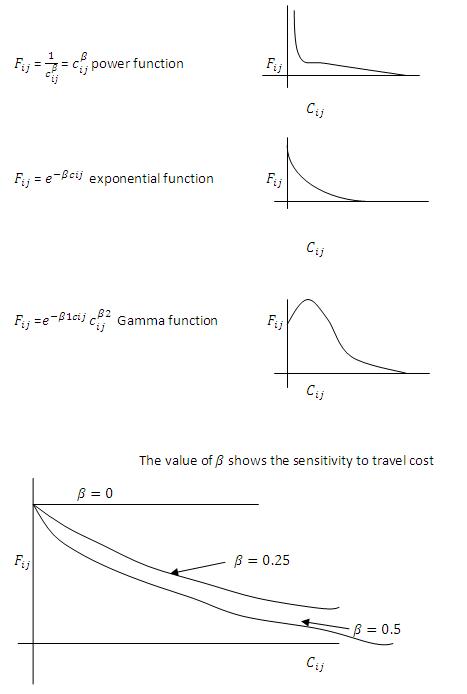
If the calibration is correct the observed and the simulated calculations will match but if they donot then a set of values of Friction Factor is calculated using the following expression:
$$\nonumber F' = F \dfrac{OD\%}{GM\%} $$This iteration is carried on till the trip length frequency curve of the observed and calculated value is obtained. The final phase of calibration procedure includes the calculation of zone to zone adjustment factor.
$$\nonumber k_{ij} = r_{ij}[ \dfrac{(1-x_i)}{(1-x_i r_{ij})}] $$- Calibration of single constrained gravity model
- Calibration of doubly constrained gravity model
- Assume a trial value of β.
- Constraint any one either Trip Production (Origin) or Trip Attraction (Destination), suppose Origin is constraint (Remember: constraint is with respect to future trips).
- A mathematical function that is selected in order to find the friction factor is calculated.
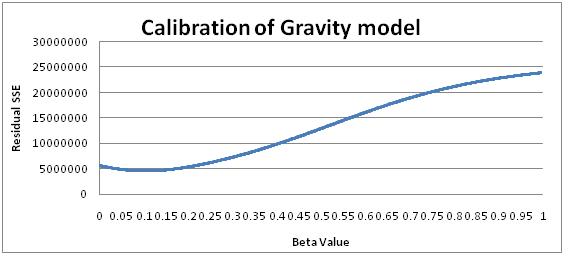
- These values are substituted in the gravity model, the calculated destination values are compared with the future values, and the error between the two is calculated with the help of Residual Standard Square of Errors.
- This error is minimised for an optimised value of β.
- At the end of the calibration we get an optimised value of β.
Calibration of Singly Constrained Gravity Model (Origin)
| Zone | 1 | 2 | 3 |
|---|---|---|---|
| 1 | 28 | 23 | 28 |
| 2 | 29 | 26 | 27 |
| 3 | 31 | 31 | 20 |
| Zone | 1 | 2 | 3 | ∑ [Oi] |
|---|---|---|---|---|
| 1 | 3413 | 126 | 231 | 3770 |
| 2 | 151 | 564 | 729 | 1444 |
| 3 | 435 | 289 | 1806 | 2530 |
| ∑ [Dj] | 3999 | 979 | 2766 |
Selected Frictional Functions: Exponential Function $\nonumber F_{ij} = e^{-\beta c_{ij}} $
| Zone | 1 | 2 | 3 |
|---|---|---|---|
| 1 | 1794 | 735 | 1240 |
| 2 | 661 | 220 | 562 |
| 3 | 745 | 182 | 1601 |
Optimal Beta = 0.103
| Target Oi | Modelled Oi | Target Dj | Modelled Dj |
|---|---|---|---|
| 3770 | 3770 | 3999 | 3201.193385 |
| 1444 | 1444 | 979 | 1138.173227 |
| 2530 | 2530 | 2766 | 3404.633388 |
References Books
- J. De D. Ortuzar and L.G. Willumsen (1996), Modelling Transport. Wiley Publications, London.
- C. S. Papacostas and P. D. Prevedouros (2001), Transportation Engineering & planning. Prentice-Hall of India, New Delhi.